Users & Licenses
User management
(Available version 25.01)
Go to Administration > User Management to create or edit users.
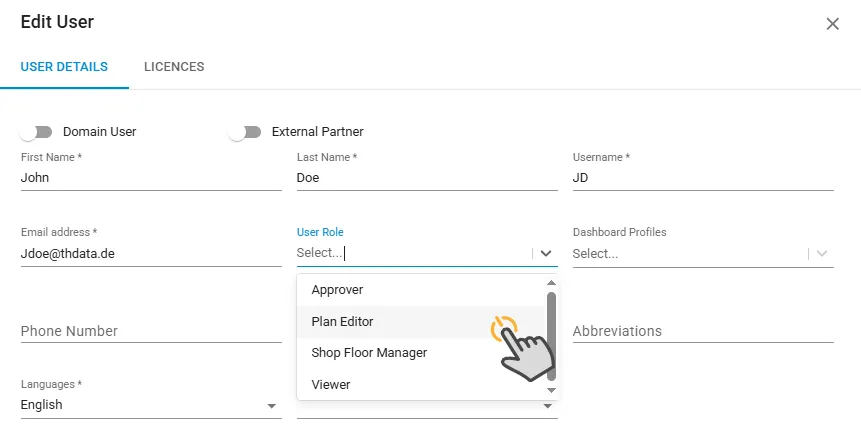
You can assign licenses to each user and choose a user role for them. User roles define what users can see and do in planeus.
Change passwords
You can change your own password under My planeus. If needed, an administrator can also update passwords for other users in User Management.
User roles
In User Management, you can set up user roles.
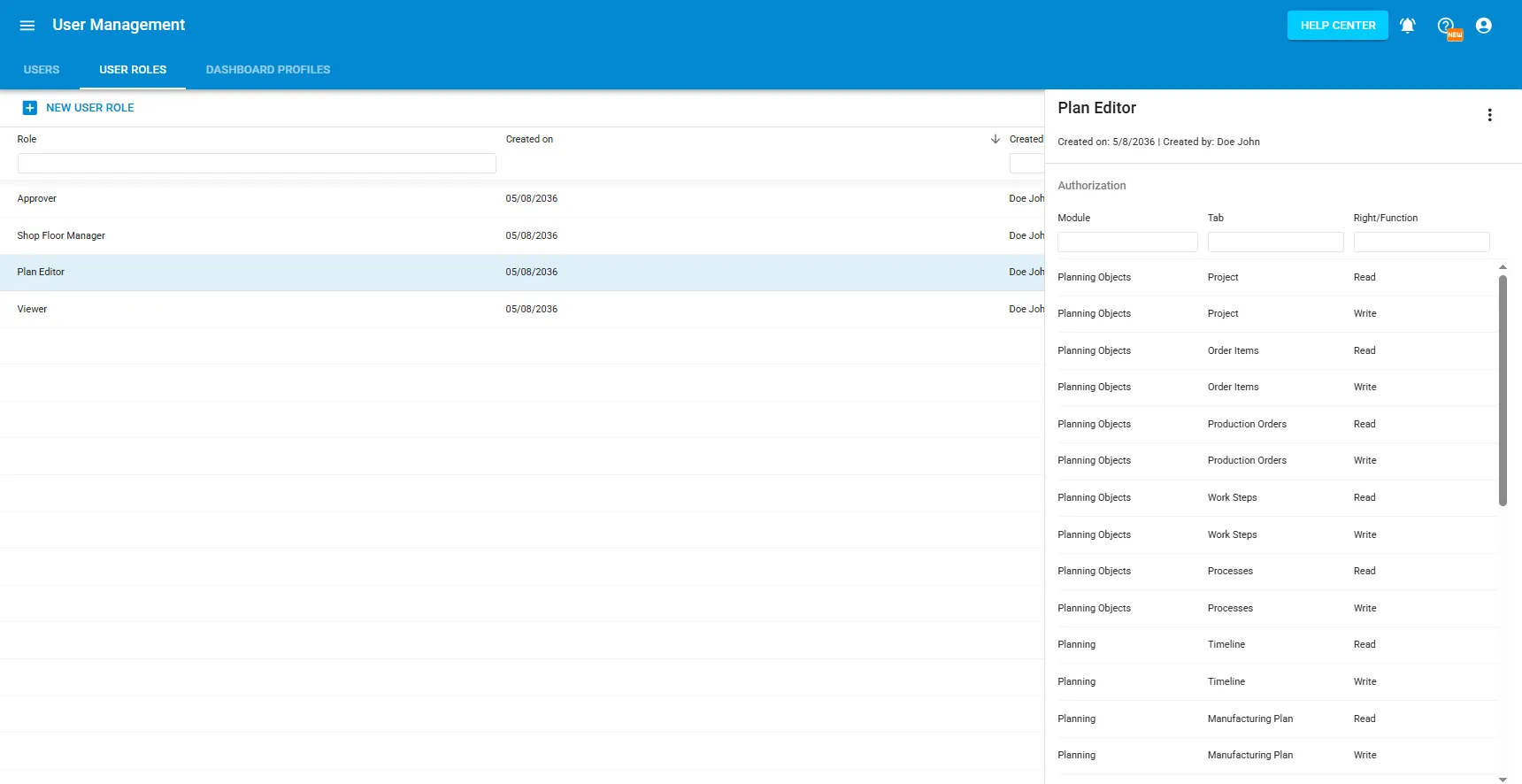
These roles let you predefine a set of profiles with different rights different modules, tabs, or specific functions in planeus, where you can later assign these profiles to each user accounts.
When you set up user roles, you can decide what each user can do in planeus. For every module or tab, you can choose these standard rights:
- Read – View data
- Write – Add or edit data
- Delete – Remove data
- Export – Export data (if available)
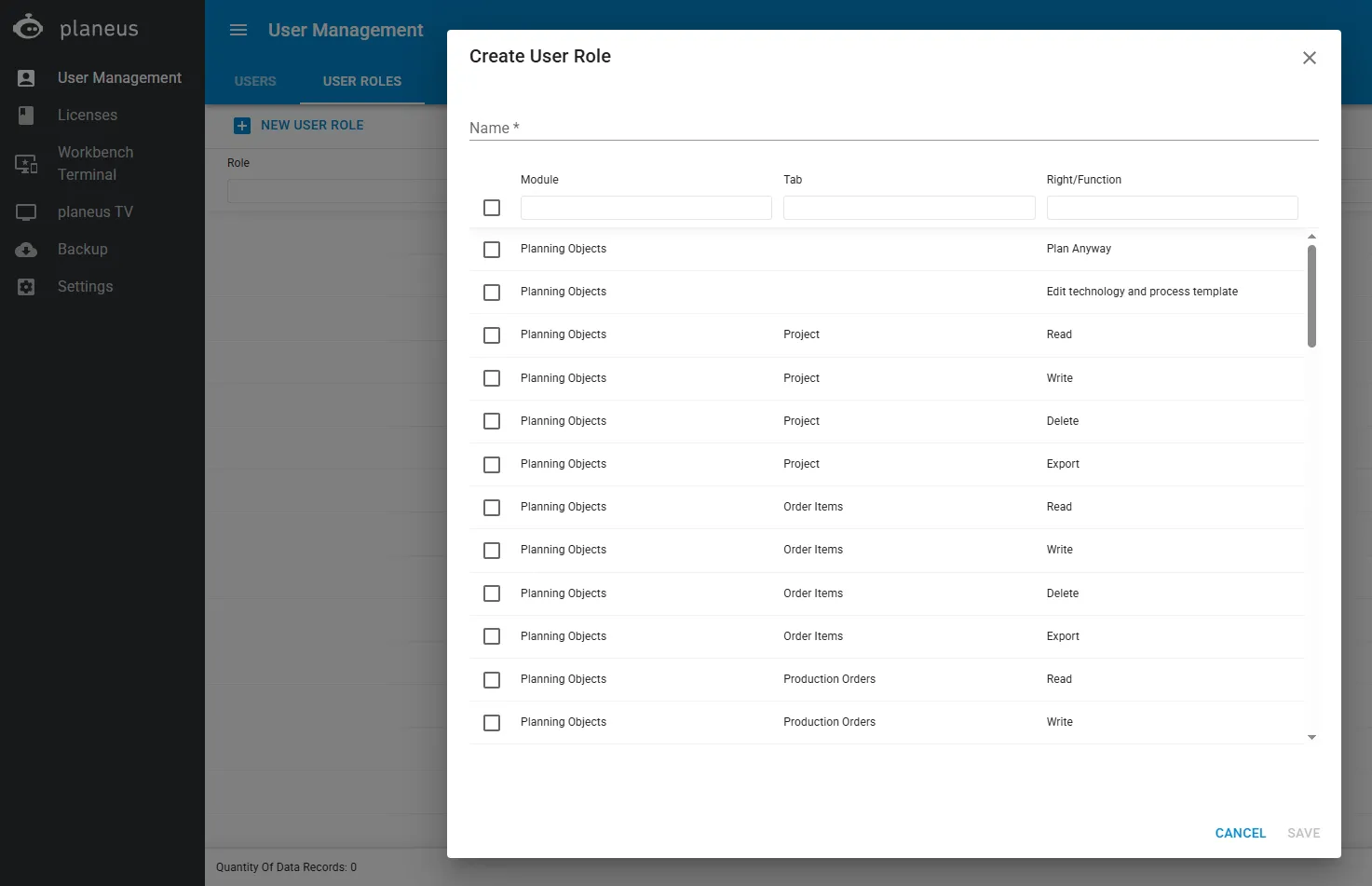
Moreover, you can give users specific rights for certain actions:
- Planning Objects: Schedule order items without constraints
- Workbench: Correct feedback entries or change the “Completed” status
- Workbench: Mark work steps as completed even if no feedback exists
- Conflict Radar: Confirm conflicts
- Conflict Radar: Confirm overdue work steps
- Planning: Edit data inside the Frozen Zone of the schedule
- Simulation: Write simulation results back into the live system
In versions before 25.1, some of these functions were available under the roles “Expert” and the option “Enable Plan Anyways.” Starting with version 25.1, planeus replaces those with the new User Roles system, so you can manage these permissions more flexibly and precisely.
Dashboard Profile
Dashboard profiles are part of User Management. Here, you can decide which Dashboard Tiles can each user see.
Users have to re-login to see the new changes made to their Dashboard profiles.
Workbench Users
A Workbench user can only see the following modules and licenses:
- Workbench
- Workbench Terminal
- Workbench Scan
Domain Users
Domain User matters only for On-Premise version of planeus. A domain user can log in with their Windows username and password through Single Sign-On (SSO). This requires prior setup by your IT-administrator.
Enable "Plan Anyway"
"Plan Anyway" is by default enabled in planeus, here you can disable it. You can find more details about this feature in Scheduling.
External Partner
You can find more details about this feature in External Partner.
Languages
planeus's publicly supported languages are as follows:
- English
- German
- French
- Spanish
Additional languages packs can be included by request.
Location
To learn more about how Locations work in planeus, see Location.
Licenses
You can find Licenses under Administration.
- Licenses are assigned per user and module (or function).
- For the Workbench Terminal and planeus TV modules, licenses are assigned per device.
Entering a new license key
A license key can be obtained via the planeus team. Without a license key and an license assigned, a user will not be able to see the relevant functions in their planeus system.
To enter a new license key:
- Go to Administration > Licenses.
- Click the Enter License Key button at the top left.
- After entering the key, you’ll see the number of available licenses for each module listed.
To assign licenses to users:
- Click on a module and open the details panel to assign users.
- Alternatively, go to User Management and assign licenses directly in a user’s details panel.