Dashboard
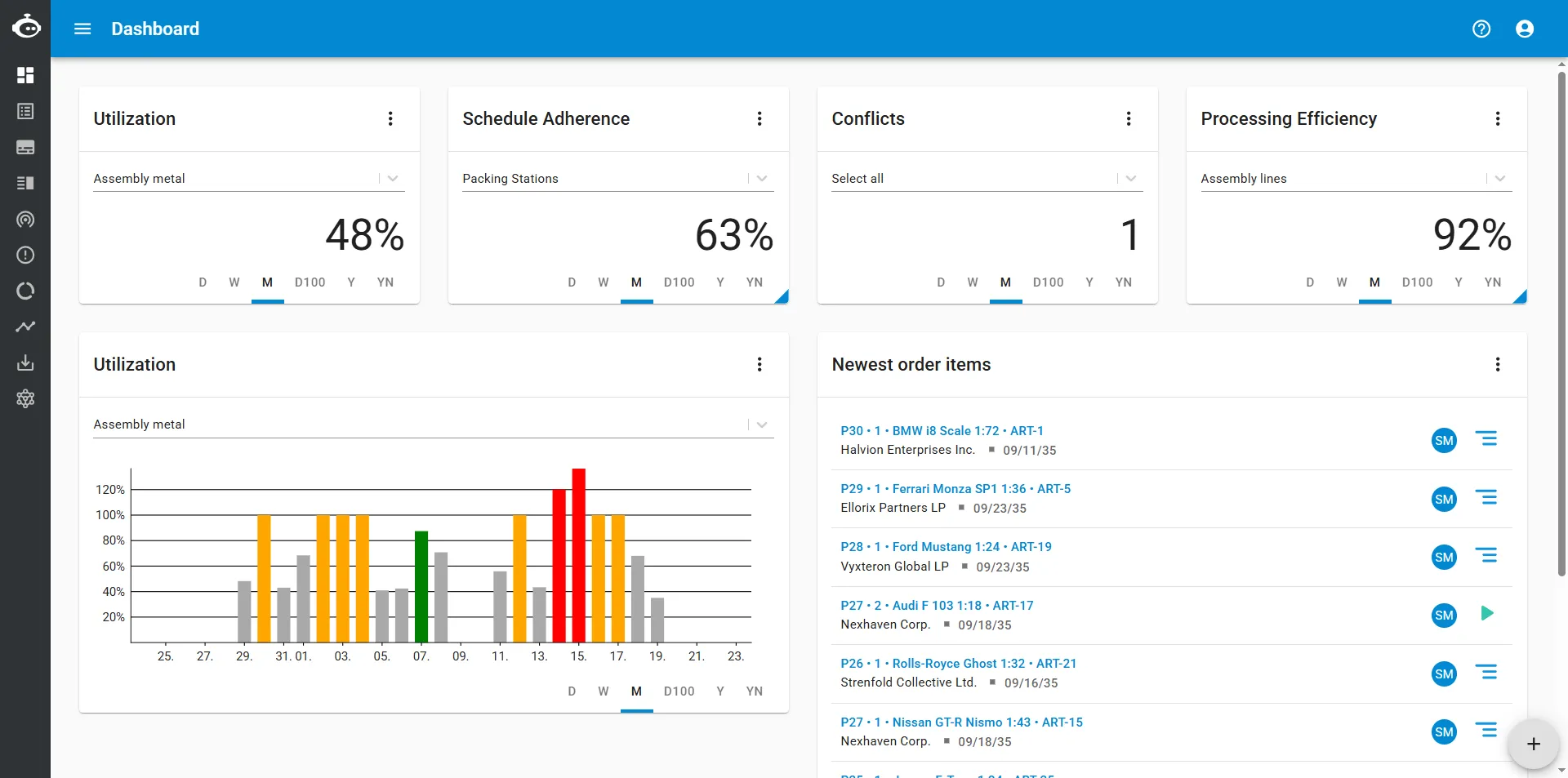
The Dashboard in planeus isn’t just any dashboard. It’s a Dashboard that qualifies your future. By taking data from your future schedule and quantifing them with KPIs, it is one of the most innovative way to turn blurry, experience-based outcome guesstimations, to realistic, measureable, and improvable metrics.
What the Dashboard shows
The planeus Dashboard gives you an automated verdict on how well your hypothetical operations are expected to perform at a future point in time.
In Dashboard, everything you see — numbers, charts, lists — is based directly on your planning data, that means you can instantly spot upcoming bottlenecks, detect issues early, and make smarter decisions way before your 1st operation begins.
Types of Dashboard Cards
The planeus Dashboard offers different cards to help you keep track of your operations:
- KPIs / Facts — Calculated metrics to monitor how your plan is expected to run.
- Charts — Visual representations of trends, capacities, and utilization.
- Lists — Up-to-date data, like active orders or work steps.
Note: Which Dashboard cards are available depends on your Dashboard Profile. You can manage them in User Management. More about Dashboard Profile
Time period for KPIs and charts
Data on KPI and Chart cards is always shown for a specific time period combined with any filters you apply. Available time periods include:
Code | Time Range Description |
|---|---|
D | Today |
W | The next 7 days |
M | The next 30 days |
D100 | The next 100 days |
Y | The next 365 days |
YN | The next calendar year |
List cards
- List cards display live data like current orders or tasks.
- Clicking on a list item takes you directly to its detailed view for more information.
Drill-Down about KPIs
For KPIs such as On-Time Delivery and Process Efficiency, you can view the underlying data:
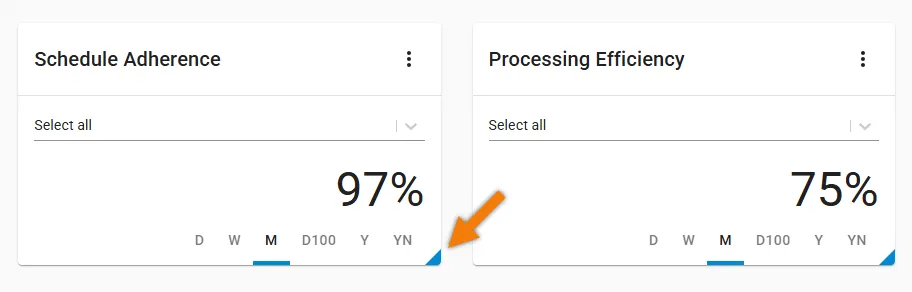
- Click the blue triangle on the dashboard tile.
- A list appears showing the detailed records behind the KPI calculation.
- From this list, click any entry to jump straight to the corresponding planning object.
Add a Tile to your Dashboard
To adjust your Dashboard:
- Click the Plus icon in the lower right corner to add a new tile.
- Choose a tile type (KPI/Fact, Chart, or List) and set its topic and parameters.
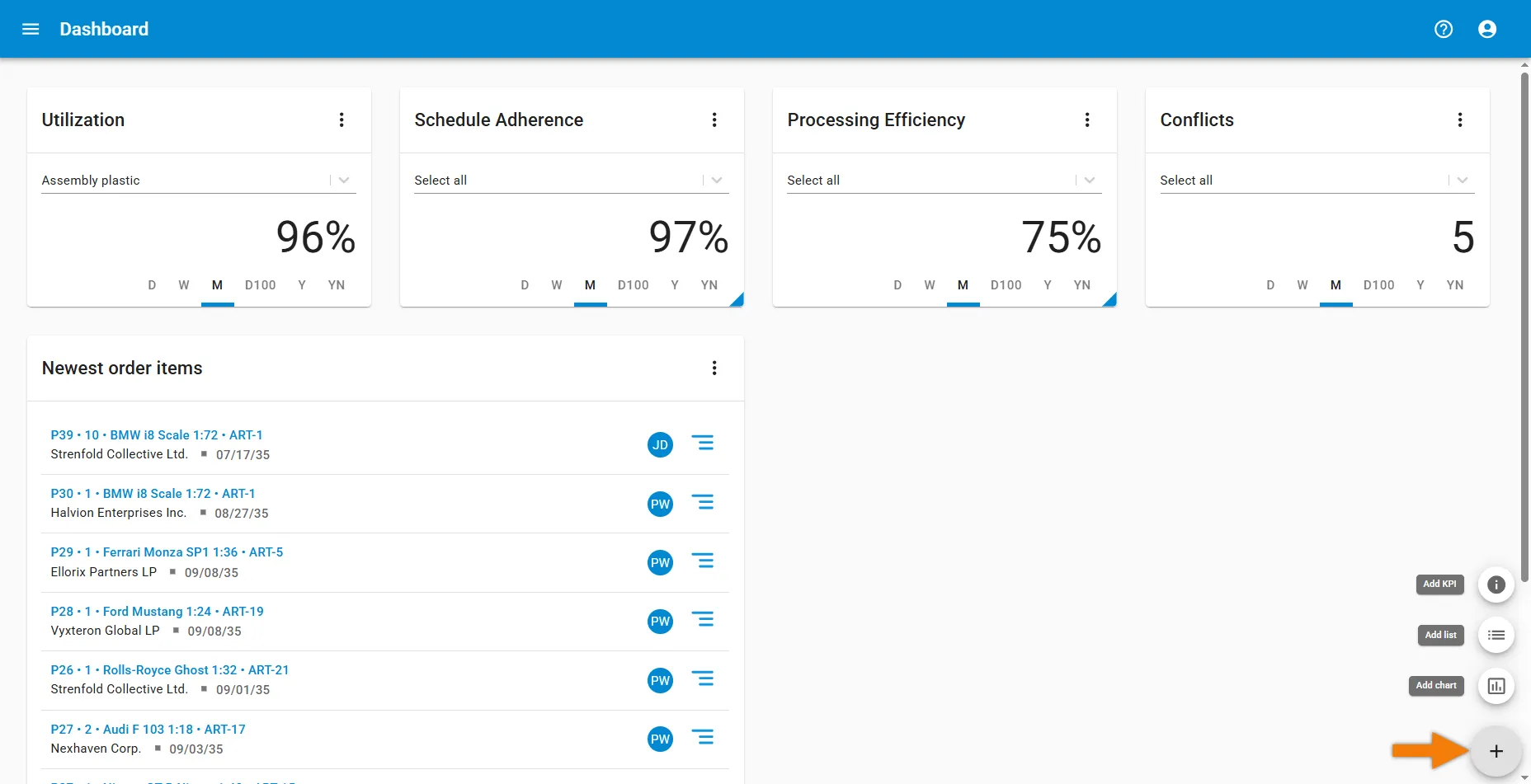
KPI/Fact cards will always appear at the top of the Dashboard for quick visibility.
Customizing Dashboard Cards
Once you add a card to your Dashboard, you can adjust its topic and further settings to fit your needs.
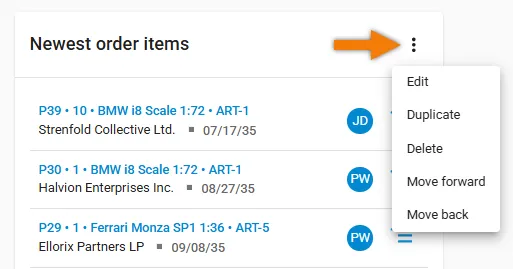
Click the three-dot icon on any cards to:
- Edit the tile’s settings
- Duplicate the card
- Delete it
- Move it around
Understanding the different Cards
Here’s what the various Dashboard Cards show:
Chart Card — Capacity Utilization
This chart displays the capacity utilization over time for a specific resource or Resource group.
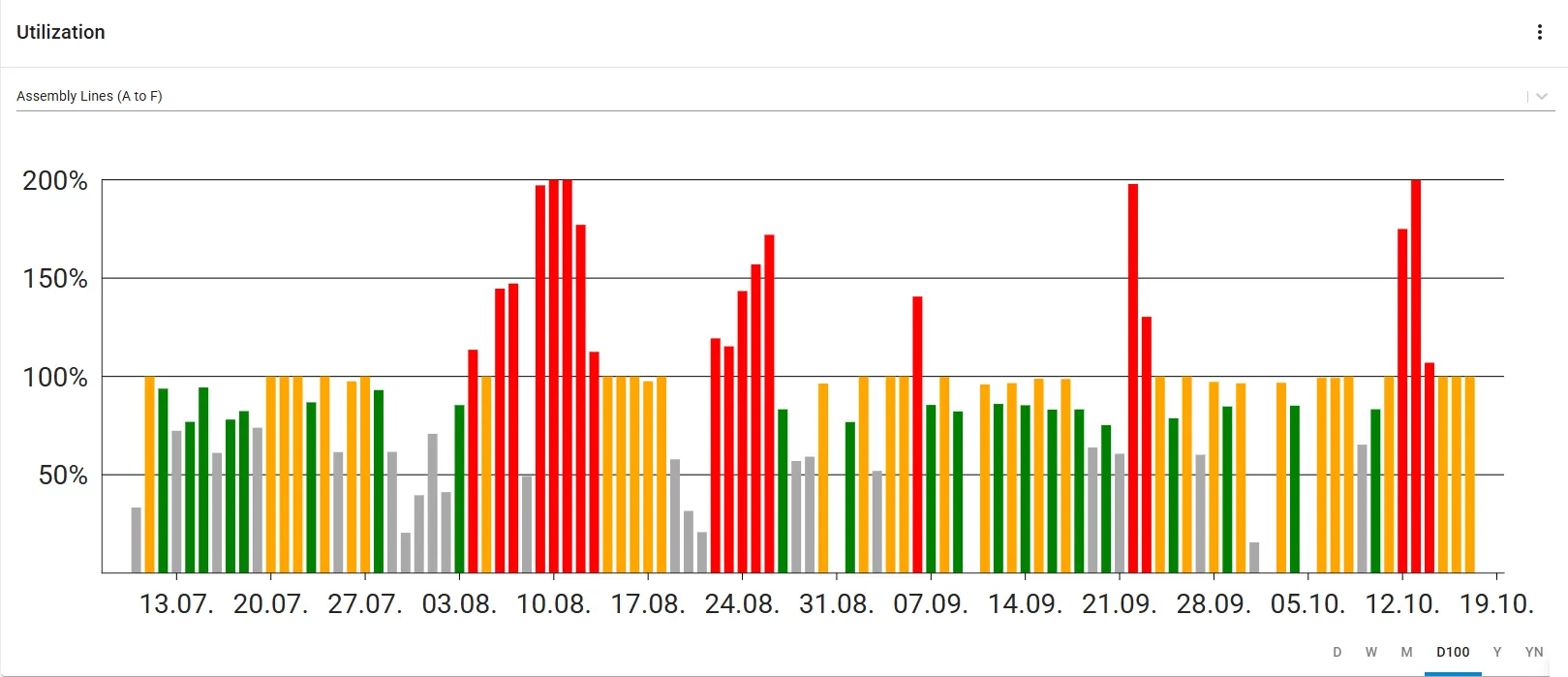
Color Coding:
Color | Meaning |
|---|---|
🟩 Green | Less than 75% utilization |
🟨 Yellow | 75% – 95% utilization |
🟧 Orange | 95% – 105% utilization |
🟥 Red | Over 105% utilization |
Bars at 100% in light gray mean the resource is completely unavailable.
For Resource Groups, unavailable times appear only when every resource in the group is unavailable at the same time.
KPI — Conflicts
- This tile counts all conflicts that affect a resource or resource group within the selected time frame.
- Only conflicts of the type “Resource Overload” are included.
KPI — Process Efficiency
- The Process Efficiency metric measures how efficiently production is planned.
- It’s calculated as:
\text{Process Efficiency}
=
\dfrac{
    \raisebox{5pt}{\text{Total time of all Work Steps}}
}{
    \text{Total planned duration of the Production Order}\rule{0pt}{13pt}
}
- It includes all Production Orders that touch the selected time range, not just those fully within it.
- A Production Order is included if at least one Work Step is scheduled on the selected resource or group.
- Parallel Work Steps on other resources are not counted in this calculation.
- Completed Production Orders are not included, since this KPI focuses on active planning rather than past performance.
KPI — On-Time Delivery
- This KPI measures how closely planned finish dates match delivery dates.
- Only active Order Items are considered, because this metric assesses current planning rather than completed work.
KPI — Capacity Utilization
- This KPI shows the average workload of a resource or Resource group compared to its availability during a specific time frame.
For Resource Groups, planeus first calculates utilization for each Resource individually, and then take the average results within the Resource Group.
How it's calculated:
\text{Utilization}
=
\left(
\dfrac{
    \raisebox{1pt}{\text{Occupied Time}}
}{
    \text{Available Time}\rule{0pt}{10pt}
}
\right)
\times
100\%- Available Time is determined by:
- Total period
- Minus breaks from capacity plans
- Minus gaps listed in the Gap List
- Minus holidays
- Occupied Time comes from all Work Steps scheduled during the selected period.
Dashboard cards provide clear, measurable insights into how your production plan is expected to perform, help you plan proactively and keep your operations running smoothly!