Quantity Limits
What It Means
By setting up the maximum quantity in quantity limits, you can decide the highest number of units your machine or workstation can handle at the same time.
For example: “This furnace can only process 100 parts in one batch.”
Once you’ve set that limit, planeus will make sure your plan never overloads the resource.
How it Works in Resources
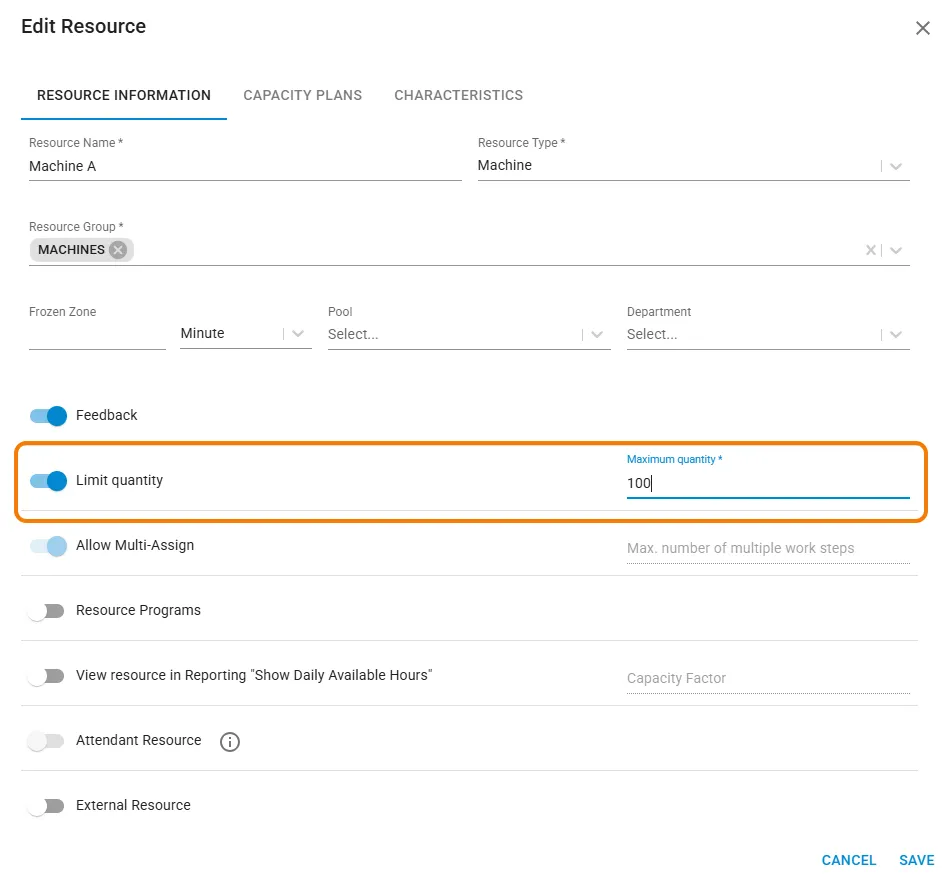
When the “Limit Quantity” option is enabled:
- In the Resource settings, you enter the maximum quantity the Resource can handle at once.
- From then on, the system will always keep this in mind when scheduling orders. You can simply type the number. Units of measurement are irrelevant here.
The following rules apply to a Resource with a Quantity Limit:
- It will become a Multi-Assignable Resource, allow processing multiple tasks at once, up to the maximum quantity you set.
- It cannot be an Attendant Resource.
- It cannot be a Parallel Resource or Installer Resource.
How it Works in Technology
In the current version of planeus, if you assign a Resource with a Quantity Limit to a Work Step:
- You must enter a setup time (the time needed to prepare the Resource before work can start).
- Under Resources with Quantity Limits, instead of the Duration/Unit time, the Setup Time will be determining the actual length of the Work Step in the Resource.
Planning Rules
When planeus schedules with maximum quantities, it follows these rules:
- Order items stay undivided The system won’t split a single order item into smaller parts.
- If the order fits, the whole item goes on the resource.
- If the order is too big, planeus will fill the Quantity on the resource up to the max. The leftover quantity is then scheduled as a follow-up task on the same resource.
- If the Resource have some free space left, a new order that fits into that space will be scheduled there.
- No overlapping allowed. When you add new Work Steps to a Resource, planeus always respects the start and end times of the Work Steps already scheduled. This means you cannot place Work Steps in a staggered or overlapping way on the same machine.
Manual Changes
If you need to stagger or move Work Steps anyway, you can do this with free move.
- To prevent mistakes, it’s best to keep Fix Production Orders enabled.
- If you need to move a specific Work Step, you can unlock it on the Gantt chart.
Example 1: Machine Capacity
- Oven A has a max quantity of 100 pieces.
- You want to run four orders:
- Order 1: 20 pieces
- Order 2: 30 pieces
- Order 3: 30 pieces
- Order 4: 40 pieces
Together, that’s 120 pieces — too much for Oven A at once.
What planeus does:

- Schedules Orders 1 + 2 + 3 = 80 pieces in parallel.
- Leaves 20 pieces free.
- Puts Order 4 = 40 pieces right after.
- So the oven never goes over 100 pieces.
Example 2: Using Remaining Capacity
- In the case above: Machine A still has space for 20 pieces.
- Now a new order comes in: 20 pieces.
- planeus fills the 20-piece gap with the new order — no wasted space.
With Quantity Limits, planeus automatically fills leftover capacity, avoids overloads, and keeps machines at the right load. Manual changes are possible, but you stay in control by fixing or unlocking orders as needed.