Scheduling
When you’re ready to plan your Order Items, click the Save or Apply button.
This action triggers planeus to create and schedule all the required elements:
- Production Orders
- Work Steps
- Processes
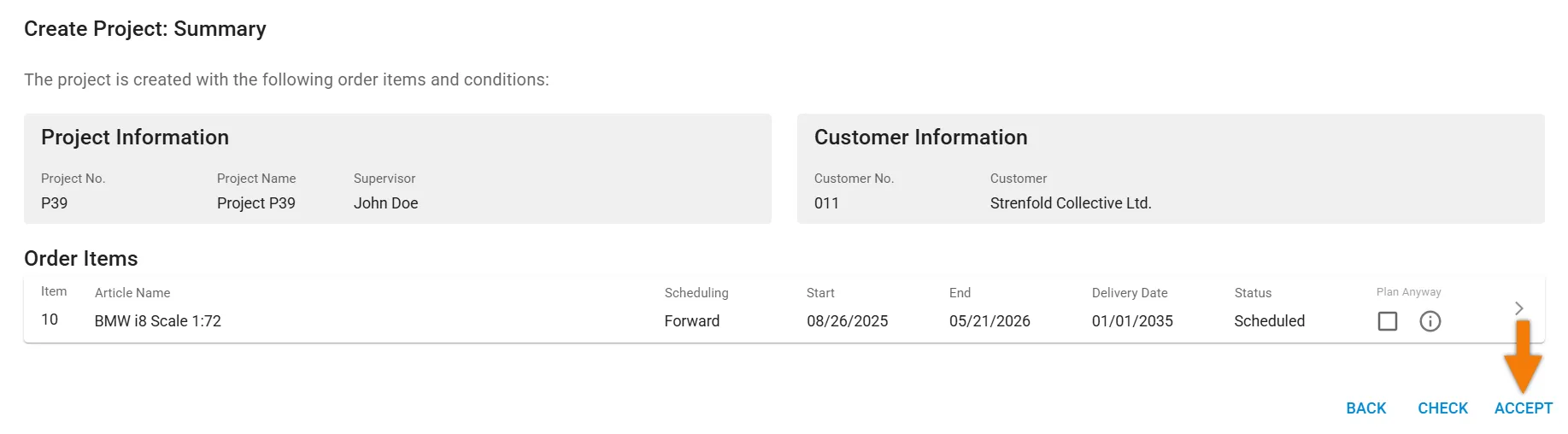
Scheduling directions
planeus supports two scheduling directions: Backward Scheduling and Forward Scheduling. Both consider resource availability, capacity plans, dependencies, and the assigned calendars to determine when production can take place.
Backward Scheduling
- Backward Scheduling starts from the delivery date and works backward to determine the latest possible start date for the Production Order.
- Starting point: Scheduling begins at 00:00 on the delivery date and proceeds backward.
- Step 1 – Schedule downstream Processes: If downstream Processes are assigned to the Production Order, they are scheduled first. Weekends and public holidays are considered based on the assigned calendar.
- Step 2 – Schedule Work Steps: Individual Work Steps are scheduled in reverse order, following these rules:
- Resource availability: planeus identifies compatible primary resources based on their defined characteristics and available capacity. Resource groups are fully considered.
- Time-slot selection: Among the compatible resources, planeus selects the available time slot closest to the delivery date.
- Capacity plans: The capacity plans assigned to the resources are considered when selecting available time slots.
- Parallel resources: The same scheduling logic applies to each required parallel resource.
- Assemblies and cycles: The scheduling process follows the same logic for assemblies and production cycles.
Why use Backward Scheduling?
Backward Scheduling helps ensure that products are completed just in time, avoiding unnecessarily early production that could tie up resources or increase inventory.
Example use cases:
- When delivery dates are critical and production needs to be aligned with customer deadlines.
- When you want to avoid producing goods too early and storing them unnecessarily.
- When minimizing finished goods, raw material inventory, or work in progress (WIP) is a planning priority.
- When shelf life, freshness, or the risk of deterioration makes it important to produce as close to the delivery date as possible.
Forward Scheduling
Forward Scheduling starts at the earliest possible point in time and schedules production forward to determine the earliest possible completion date.
- Starting point: Scheduling begins at now + 1 hour or from the defined planning start date.
- Step 1 – Schedule upstream Processes: If upstream Processes are assigned to the Production Order, they are scheduled first. Weekends and public holidays are considered based on the assigned calendar.
- Step 2 – Schedule Work Steps: Individual Work Steps are scheduled sequentially, following these rules:
- Resource availability: Planeus identifies compatible primary resources based on their defined characteristics and available capacity. Resource groups are fully considered.
- Time-slot selection: Among the compatible resources, planeus selects the earliest available time slot from the planning start date.
- Capacity plans: The capacity plans assigned to the resources are considered when selecting available time slots.
- Parallel resources: The same scheduling logic applies to each required parallel resource.
- Assemblies and cycles: The scheduling process follows the same logic for assemblies and production cycles.
- Delivery date consideration: The entire delivery date is treated as an available planning day and can be fully included in the schedule.
Why use Forward Scheduling?
Forward Scheduling helps ensure that production is completed as early as possible, making available capacity usable sooner and providing additional flexibility before delivery deadlines.
Example use cases:
- When you want to complete work early to have extra flexibility.
- When it might be safer to have products ready ahead of time.
- When you want to maximize the use of your resources (e.g., equipment and people) shortly after your planning progress.
Forward Scheduling helps ensure that production is completed as early as possible, making available capacity usable sooner and providing additional flexibility before delivery deadlines.
Example use cases:
- When you want to complete work early to create additional scheduling flexibility.
- When having products ready ahead of the delivery date reduces the risk of delays.
- When you want to make efficient use of available equipment and personnel capacity at the earliest possible opportunity.
Special Scheduling Rules
The following rules apply to both scheduling directions where relevant.
Fixed Start Dates
If a fixed start date is defined for a Work Step, that Work Step becomes the scheduling anchor and is scheduled first.
- All preceding Work Steps are scheduled backward from the fixed date.
- All subsequent Work Steps are scheduled forward from the fixed date.
- The standard resource compatibility, capacity, and time-slot selection rules continue to apply in both directions.
This allows planeus to accommodate fixed production commitments while scheduling the remaining Work Steps around them.
Resource Priorities
When resource priorities are defined, they take precedence over the standard best-available-time-slot selection.
- Planeus prioritizes the resource with the highest assigned priority, rather than automatically selecting the resource offering the earliest available time slot.
- If multiple resources have the same priority, the standard time-slot selection rules apply.
This allows planners to favor preferred machines or resources when several compatible alternatives are available.
Employee as a Parallel ResourcePersonnel as a Parallel Resource
Special scheduling considerations apply when employees are assigned as parallel resources. These are described separately in the corresponding documentation.
Plan anyway
The Plan anyway feature lets you schedule an Order Item even if there’s no capacity available at that selected time frame.
This means planeus will fit the order into your schedule no matter what.
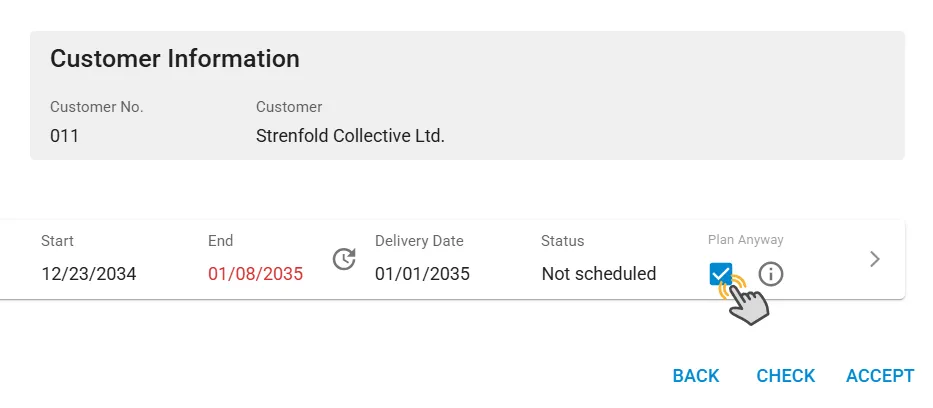
This will create Conflicts that you’ll need to resolve manually later.
Why use Plan anyway?
- When an order is urgent and must be scheduled, and you’re prepared to move other work around to make it happen.
- When you want to see how your plan would look if you forced an order in, so you can decide what to adjust.

Throughput Time Optimization
By default, planeus tries to optimize the throughput time for every Order Item during scheduling. Here’s how it works:
- In Forward Scheduling:
- planeus first plans all Work Steps forward.
- Then it checks if backward scheduling would result in a shorter total time.
- In Backward Scheduling:
- planeus first plans backward.
- Then it tests if forward scheduling would be quicker.
- planeus compares both results and chooses the shortest option for you.
You can disable throughput time optimization in Settings.
- If disabled, planeus will stick to whichever direction (forward or backward) you’ve selected.
Unscheduling & Rescheduling
In planeus, you can unschedule and reschedule your Order Items to keep your plan flexible and up to date.
Unscheduling
If you need to remove an Order Item from the plan:
- Go to the Master Data
- Click on Order Item tab
- Go to the Detail Panel of the Order Item you want to remove from the plan.
- Choose Unschedule Order Item.
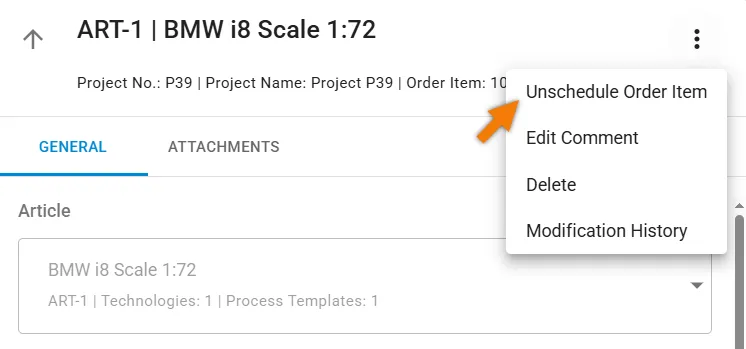
All related Planning Objects (Production Orders, Processes, Work Steps, and Feedback) are deleted when you unschedule.
Rescheduling
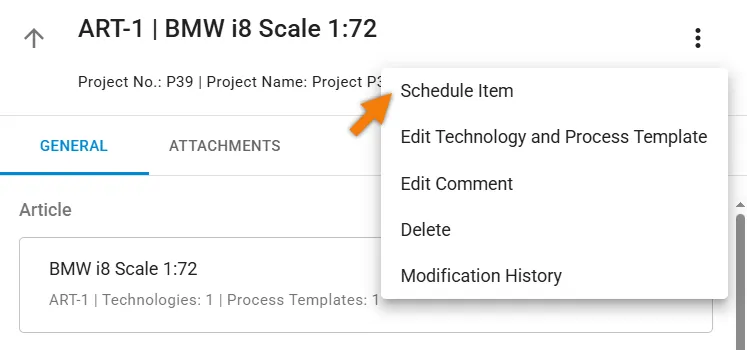
Order Items that are unscheduled can be rescheduled at any time:
- Use the Schedule function to plan them again.
Warning About Feedback
If some progress feedback has already been recorded for an Order Item, you’ll see a warning:
“This Order Item already contains feedback. Unscheduling will delete this feedback. Do you want to continue?”
Pausing Production Orders
Instead of unscheduling, you can use the Pausing Production Orders feature.
- This keeps your Planning Objects and feedback unaffected by changes.
- It lets you pause work without losing any progress.
Scheduling Order Items with Sorting
When you select several Order Items using batch select and schedule them together, you can define the order in which they should be planned.
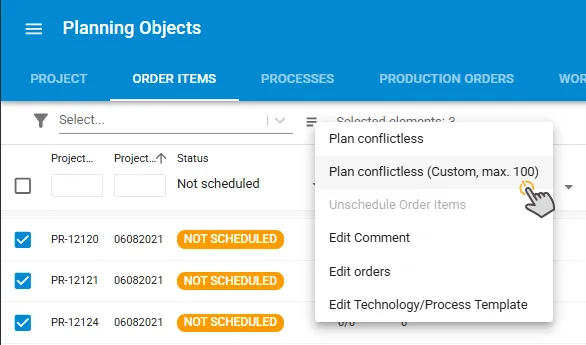
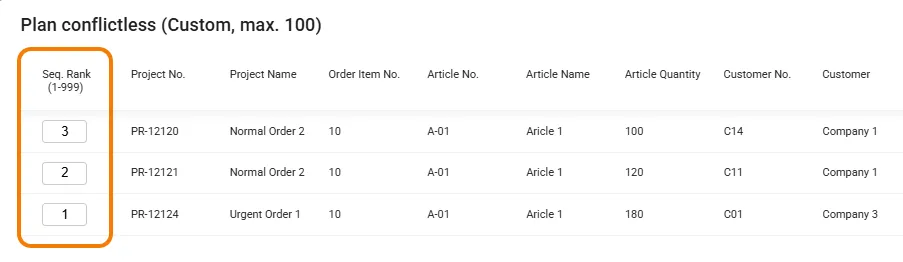
This helps you prioritize important Order Items and reduce resource allocation conflicts during scheduling.
Planning Order With Batch Select
When you select and schedule several Order Items at the same time, planeus will schedule the batch-selected orders by the following hierarchy:
- Sequencing Ranks Order Items with a Sequencing Rank ("Seq. Rank") are planned first. The lower the rank number, the earlier the Order Item is planned.
- Characteristics for Sequence If no Sequencing Rank is entered, or if several Order Items are on the same Sequencing Rank, planeus will check their Characteristic for Sequence
- Delivery dates If the Sequencing Ranks and Characteristics for Sequence are empty or the same, planeus uses the delivery date. Order Items with the earliest delivery date is planned first.
This helps you plan important Order Items first and reduce Resource conflicts.
Special Case: Only Part of the Order Items Have Sequencing Ranks
If only some Order Items have a Sequencing Rank, planeus plans those first.
The remaining Order Items are planned afterward by delivery date, unless a Characteristics for Sequence is available.
Behavior During Import
The same logic applies when Order Items are imported.
If no Sequencing Ranks is defined, planeus plans the sequence mainly by delivery date, with the earliest date first, unless a Characteristics for Sequence is available.
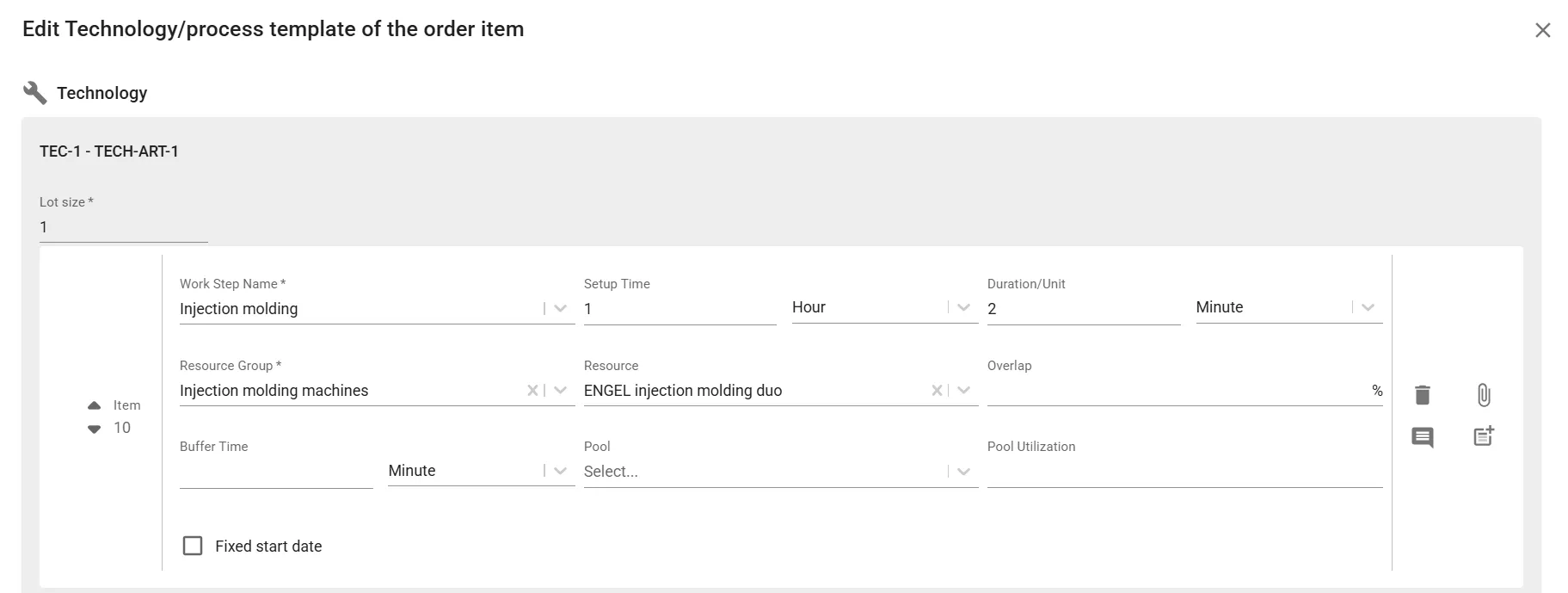
Editing Technologies & Process Templates
You can edit the Technology or Process Template for any Order Items:
- These changes only affect the specific Order Item. And they do not change the Article Master Data.
- You can also edit the Bill of Materials (BOM) during this process.
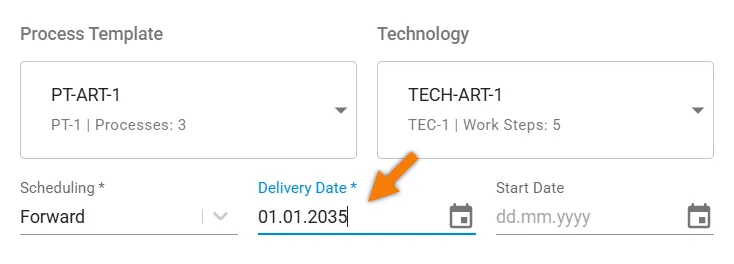
Changing Delivery Dates
- You can change the delivery date for any Order Item, even after it’s been scheduled.
- Changing the date doesn’t automatically unschedule the item.
Special Note for Imported Orders Items
For imported Order Items, there’s a setting “Changed delivery dates trigger rescheduling” under Administration > Settings
- If this setting is enabled (default), changing the delivery date will automatically unschedule the Order Item.
- If it’s disabled, you can change dates without affecting the schedule.